Quick answer. Under ISU Rule 501, a skater's clothing must be modest, dignified and appropriate for athletic competition — not garish or theatrical — though it may reflect the character of the music. Women may wear a dress, trousers or a unitard in every discipline; men must wear full-length trousers, not leggings or tights. Props and accessories put on or taken off during the program are not allowed. A costume that breaks the rule costs −1.0, and so does any part of a costume or its decoration that falls on the ice.
Figure Skating Costume Rules: What the ISU Allows, What Costs Points, and How We Got Here
The ISU costume rule is one of the few in sport without a single number in it.
Just "modest," "dignified" and "not theatrical." What that means is decided by the judges, during the program.
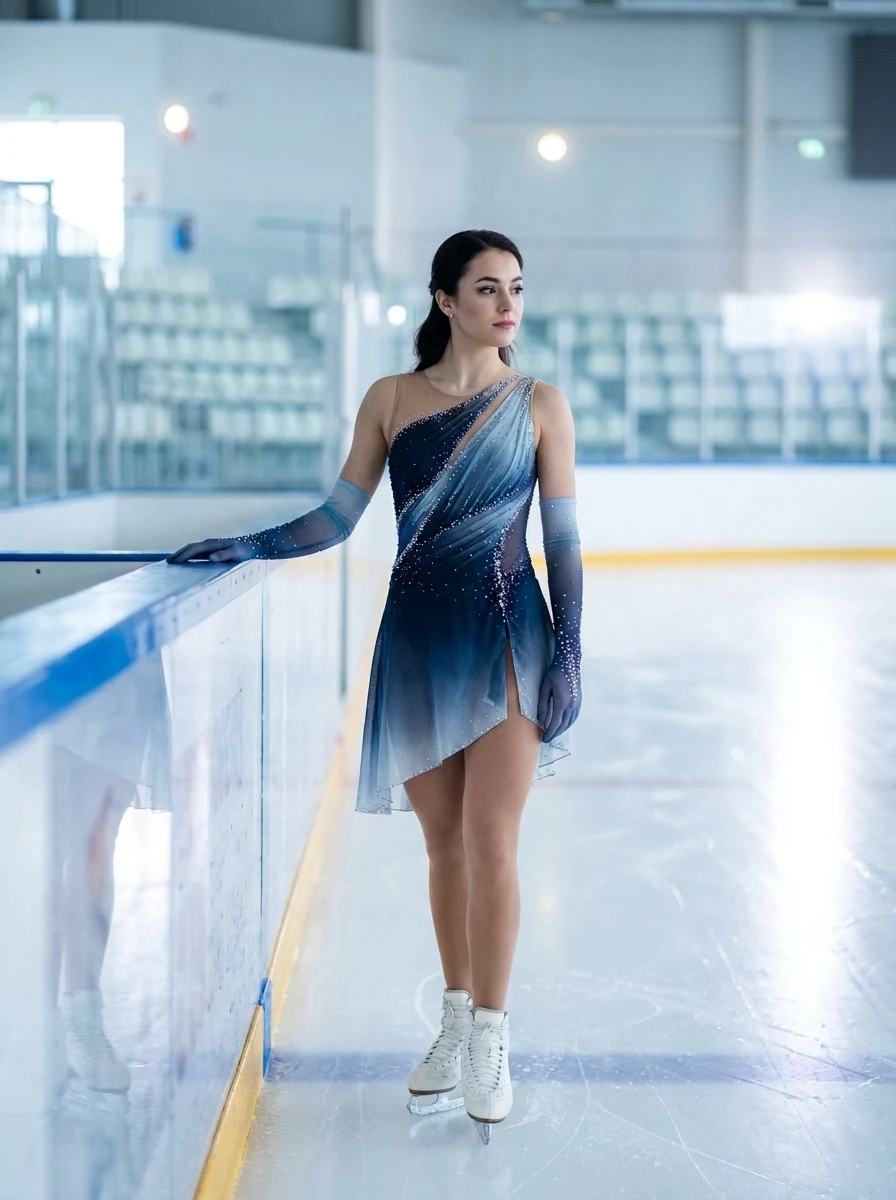
A week before the first competition of the season, the same message lands in every dressmaker's inbox. A photo of the dress, a slightly blurry close-up of the neckline, and one question: *"Is this okay? They won't take points off for this, will they?"*
The honest answer is shorter than most people expect — and, unlike rhythmic gymnastics, it has nothing to do with a tape measure.
Where the Costume Fits in the Scoring
A figure skating score has two halves: the Technical Elements Score (jumps, spins, step sequences, lifts) and the Program Component Score (skating skills, composition, presentation). Deductions are then taken off the total — for falls, time violations, and, among other things, a costume that doesn't meet the rules.
That last part matters more than it seems. The costume is not part of the artistic score. Judges don't reward a beautiful dress with higher components, and they don't quietly mark down one they find tacky. A costume problem is a fixed technical deduction, decided by a majority of the judging panel together with the referee. It's either a violation or it isn't.
How the Figure Skating Dress Evolved: From Wool Petticoats to a $9,000 Dress
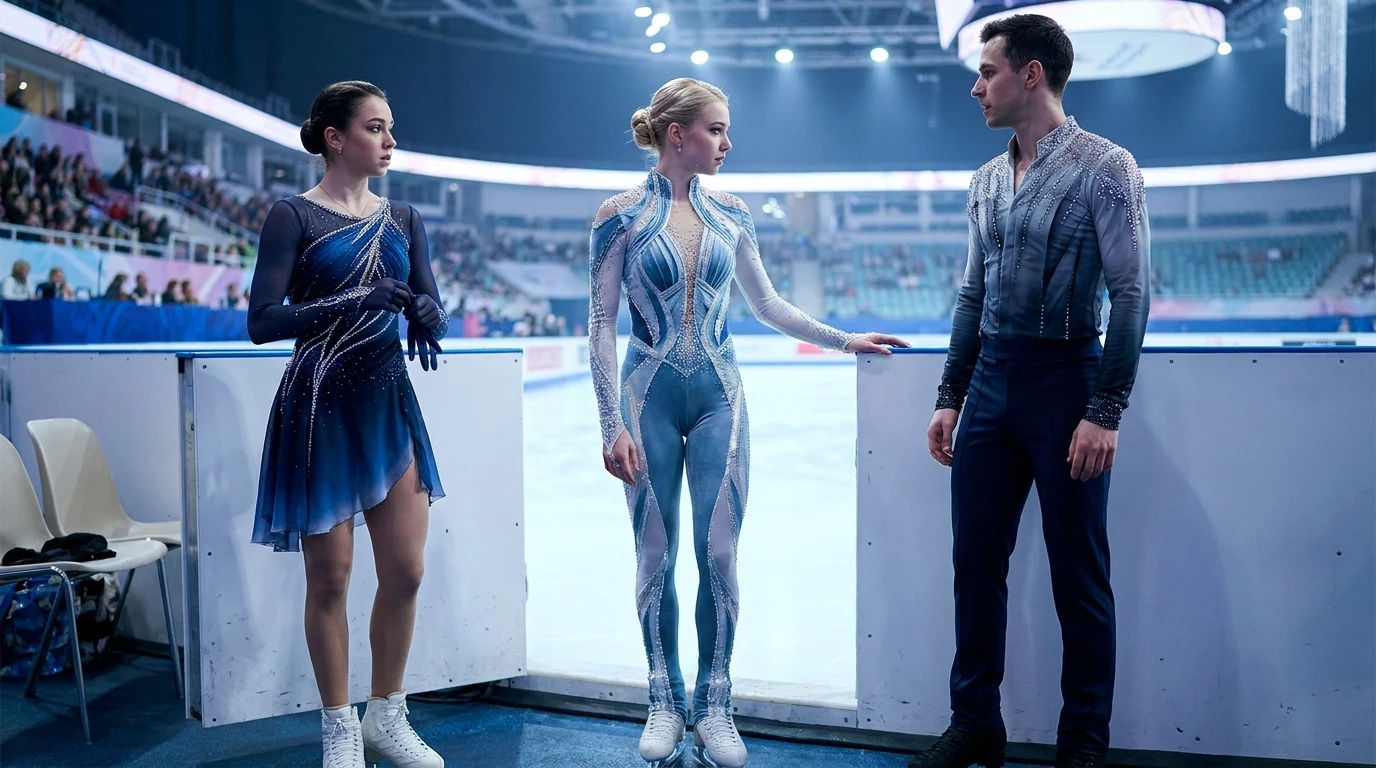
The 1890s: dressed for the cold, not for the jumps. When skating turned into a sport with rules and championships, it was held outdoors, and the first job of any outfit was keeping the skater warm. Women competed in heavy wool skirts over padded petticoats and tight corsets — clothing that limited movement and made every fall genuinely dangerous.
1902: Madge Syers and the skirt that hid the skates. The World Championships were then open only to men — until British skater Madge Syers entered and finished second. The ISU responded by closing the event to women, and one of the official reasons given was that long skirts kept the judges from seeing the skater's feet. Syers had made her debut in a full-length skirt; to let the judges see her footwork, she switched to a calf-length one — and set the fashion for decades.
1924–1936: from winter clothes to the short dress. At the first Winter Olympics in Chamonix in 1924, women skated in skirts, sweaters and hats — essentially what they'd wear for a winter walk. The turning point came at Garmisch-Partenkirchen in 1936, when Norway's Sonja Henie, already a three-time Olympic champion, skated in a short dress. Hemlines have been going up ever since.
The post-war years: fabric shortages and the first bright dresses. During World War II, fabric was scarce and costumes were often sewn at home from whatever was available. At the 1947 World Championships, every woman competed in a short, mostly pleated skirt. The 1950s brought light, full-skirted dresses that flared beautifully in a spin. Men settled into an unofficial uniform — dark trousers and a sweater — with a belt, a watch or a hat as the only room for personality.
The 1960s: the ISU's first (optional) guidelines. After the 1962 Worlds, where Czechoslovak ice dancers Eva Romanová and Pavel Roman won the title in matching coral costumes, the ISU issued non-binding costume guidelines. They criticized "short, flashy costumes more suited to a carnival or ice show" and encouraged "dignified, restrained" clothing. It didn't stick: by the 1969 Worlds, most dance couples were color-coordinated anyway.
The 1980s: the first official rule. Stretch fabrics arrived, and with them chiffon, sequins and beading. At the 1988 Calgary Olympics, East Germany's Katarina Witt skated in a blue costume trimmed with feathers instead of a skirt, and it started an argument about how much was too much. At the same Games, American Debi Thomas — Witt's rival in the famous "Battle of the Carmens" — skated in a form-fitting black unitard with silver sequins and no skirt at all, and went home with the bronze. That summer, the ISU introduced its first official clothing rule: women had to wear a skirt, certain areas of the body had to be covered, and heavily decorated costumes were discouraged.
2003–2004: the restrictions are lifted. Both requirements — the mandatory skirt and the mandatory coverage — were dropped in 2003. From 2004, women in singles and pairs were officially allowed to compete in trousers or a unitard, even though the dress remained the most popular choice.
2022: no more mandatory skirt, even in ice dance. Ice dance held on to the skirt rule the longest. In June 2022, the ISU removed that too. Today, in every discipline, the choice between a dress, trousers and a unitard belongs to the skater.
Today: the costume as part of the program. A modern competition costume is a full design project built around one program and one skater. It's developed together with the choreographer, matched to the music, and often reworked during the season. The crystals are still set by hand — and how well that's done affects not only how the dress looks, but the score.
ISU Rules: What Gets Checked Before the Skater Steps on the Ice
The current rule lives in the ISU's *Special Regulations & Technical Rules: Single & Pair Skating and Ice Dance*, Rule 501 "Clothing." The full document is published on the International Skating Union website.
In plain words, paragraph 1 says:
- clothing must be modest, dignified and appropriate for athletic competition — not garish or theatrical in design;
- it may reflect the character of the music;
- it must not give the effect of excessive nudity inappropriate for the discipline;
- men must wear full-length trousers — no leggings or tights;
- props and accessories put on or taken off during the program are not allowed.
Here's what surprises people coming from gymnastics: there are no numbers. No maximum neckline depth, no leg-cut height, no back measurement. Whether a costume complies is decided by a majority of the judging panel together with the referee.
If you skate in national-level events, your federation — U.S. Figure Skating, Skate Canada, British Ice Skating and others — applies its own rulebook, built on the same principles. It's always worth checking the current edition before the season starts.
ISU Costume Rules at a Glance
| Element | Allowed? |
|---|---|
| Women: dress, trousers or unitard (skater's choice) | Yes |
| A mandatory skirt in any discipline | No — removed in every discipline |
| Men: leggings or tights instead of trousers | No |
| Props put on or taken off during the program | No |
| Decoration that can come loose (beads, crystals, feathers) | Allowed — but −1.0 if it falls on the ice |
| Costume maker's logo within the size limits | Yes, with limits |
The Costume Itself
Women in singles, pairs and ice dance can choose a dress, trousers or a unitard — all three are officially allowed. The dress is still the most common choice, but that's tradition, not the rulebook.
Men in every discipline must wear full-length trousers. Leggings, tights and any close-fitting alternative are not allowed.
The costume has to cover the body enough to avoid the effect of excessive nudity and shouldn't look like a carnival or stage costume. But the exact depth of a neckline, a slit or a low back isn't defined anywhere — it's a judgment call, not a measurement.
Props and Accessories
Anything the skater puts on or takes off during the program is a prop, and props are not allowed. A hat worn for the whole program isn't a prop. The same hat, deliberately taken off mid-program, is — and it gets penalized.
Construction and Secure Decoration
A costume must stay in one piece through the whole program — jumps, lifts and spins included — without coming undone or tearing. Elastic straps and Velcro are commonly used to secure sleeve cuffs and trouser hems. Beads and crystals must be attached securely: a crystal on the ice isn't just a deduction, it's a hazard for the next element — for this skater or the next one.
Advertising and the Maker's Logo
ISU advertising rules allow one costume manufacturer's logo, within a set size. The costume can carry a maker's name — it can't become a billboard.
How Many Points Does a Costume Violation Cost?
| Violation | Deduction |
|---|---|
| Costume or prop doesn't comply with Rule 501, paragraph 1 | −1.0 per program |
| Part of the costume or decoration falls on the ice during the program | −1.0 per program |
Both deductions are decided by a majority of the judging panel together with the referee, and each is applied once per program — no matter how many crystals ended up on the ice.
Fun fact. In 1988, one dress changed the rules for everyone. Katarina Witt's feathered blue costume at the Calgary Olympics was the direct trigger for the ISU's first official clothing rule — known unofficially in the skating world as "the Katarina rule." It's long gone now, but the story of a single costume rewriting a sport's regulations is still told in every rink.
How Much Does a Figure Skating Dress Cost?
The budget depends not just on the crystals but on how many costumes a skater needs. A typical season calls for at least two — one for the short program or rhythm dance, one for the free skate or free dance — and costumes are sometimes reworked mid-season, as Madison Chock's was ahead of the 2026 Games. Many skaters also have a simpler dress for tests and practice, separate from the competition costume.
The price range. According to sports media, an Olympic-level costume costs anywhere from $1,000 to more than $9,000, with around $3,000 as a realistic floor at the elite level. At club and junior level, a custom competition dress usually runs $300–800 — the range where most specialist dressmakers who sew competition costumes for young skaters work.
The labor. An elite costume takes a designer 90 to 135 hours. Most of that time goes into hand-setting crystals and fitting the dress to the skater, not into cutting and sewing.
Fabric and construction. The costume has to be made from stretch fabric with reinforced seams that won't give way in a jump, a spiral or a lift. Construction matters more than decoration here: the deduction isn't for a dress that's too plain — it's for one that comes apart or drops a piece on the ice.
Who pays. A few national federations cover part of the costume cost for top-level athletes — usually no more than half, and only from a certain level of results. For almost everyone else, the costume is a family expense.
A Pattern Made to Your Measurements — Where a Good Fit Starts
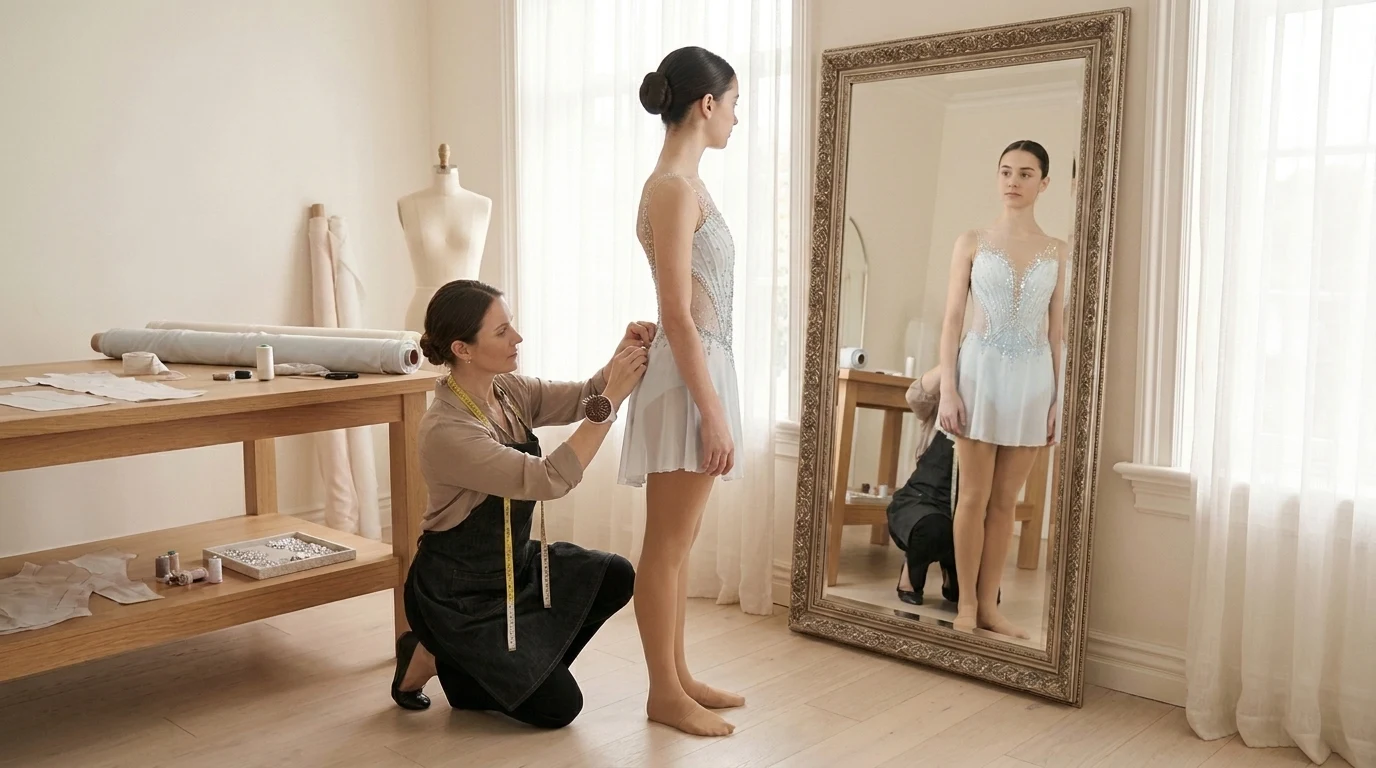
A skating costume moves in ways ordinary clothing never has to: jumps, throws, lifts, spins at high speed. The bodice and sleeves have to fit close without limiting range of motion, and the seams have to hold their shape under loads a regular dress will never see. That fit starts with the pattern.
With AROA, it takes a few minutes: you enter the skater's measurements and get a ready-to-use digital pattern built for that body. Print it straight away, or open it in a graphics or CAD program and keep working on the design — for example, develop the back of the dress from a single photo.
Build your pattern in AROA and get a ready-made base to work from.
Create a pattern from your measurements →
Rhythmic Gymnastics Leotards: History, FIG 2025–2028 Rules, and How Much They Really Cost
Artistic Gymnastics Leotards: History, FIG 2025–2028 Rules, and What They Really Cost
Competition Costume Niches
How to Create a Leotard Back Design from a Photo
How to Measure for a Leotard

Your First Pattern — Free
Rhythmic Gymnastics Leotards: History, FIG 2025–2028 Rules, and How Much They Really Cost
Artistic Gymnastics Leotards: History, FIG 2025–2028 Rules, and What They Really Cost
Competition Costume Niches
How to Create a Leotard Back Design from a Photo
How to Measure for a Leotard