Why raising your prices feels scarier than working at a loss
When and how to raise your sewing prices.

You can spend years getting better at your craft, collecting thank-yous and regular orders. And then one day you hear: "For that price, I'll find someone cheaper." Somehow those are the words that stick. Next time, quoting a new price feels scary, even though you know what your work is worth.
In the last article, «How many orders you need just to break even», we looked at the money side of running a sewing business. But it turns out the numbers are the easy part. The hard part is getting past the fear of hearing no.
In "Thinking, Fast and Slow", Daniel Kahneman offers the reader a simple bet on a coin toss: lose $100 or win $150. The possible win is bigger than the possible loss, yet many people turn it down. As Kahneman puts it: "For most people, the fear of losing $100 is more intense than the hope of gaining $150."
This is loss aversion, a quirk of decision-making that Kahneman studied together with Amos Tversky. Their work has nothing to do with sewing or pricing. But it explains a familiar situation: we notice right away that one client might walk, while the money we leave on the table month after month never feels like a loss at all.
Then there's habit. Your clients have already accepted the old price; the new one is untested. It feels especially awkward with people you've worked with for years. Some makers worry about hurting the relationship. Others look at the studio down the street and decide they have no right to charge more. But someone else's price tells you nothing about their profit, their costs or the quality of their work.
2. Signs it's time to raise your prices
Your price has stayed the same, but materials cost more. Or the same work now takes you longer. Either way, you're earning less for the same number of orders.
Look at your last few projects: what you spent on materials, how long the sewing actually took, and what was left after paying yourself and covering your studio costs. Don't estimate the time from memory. The free Order Log from «Where Does the Time Go? 10 Time Drains in a Sewing Business» lets you compare the days you planned with the days it really took, including fittings, messages and changes.
You may not need to raise everything at once. Sometimes it's enough to reprice a few items, or to start charging for extras you used to do for free.
3. What if you get fewer orders?
That can happen. But let's look at how much your studio actually keeps when there are fewer clients and the price is higher.
Take a simple example. Materials and labor for each order cost 80 units.
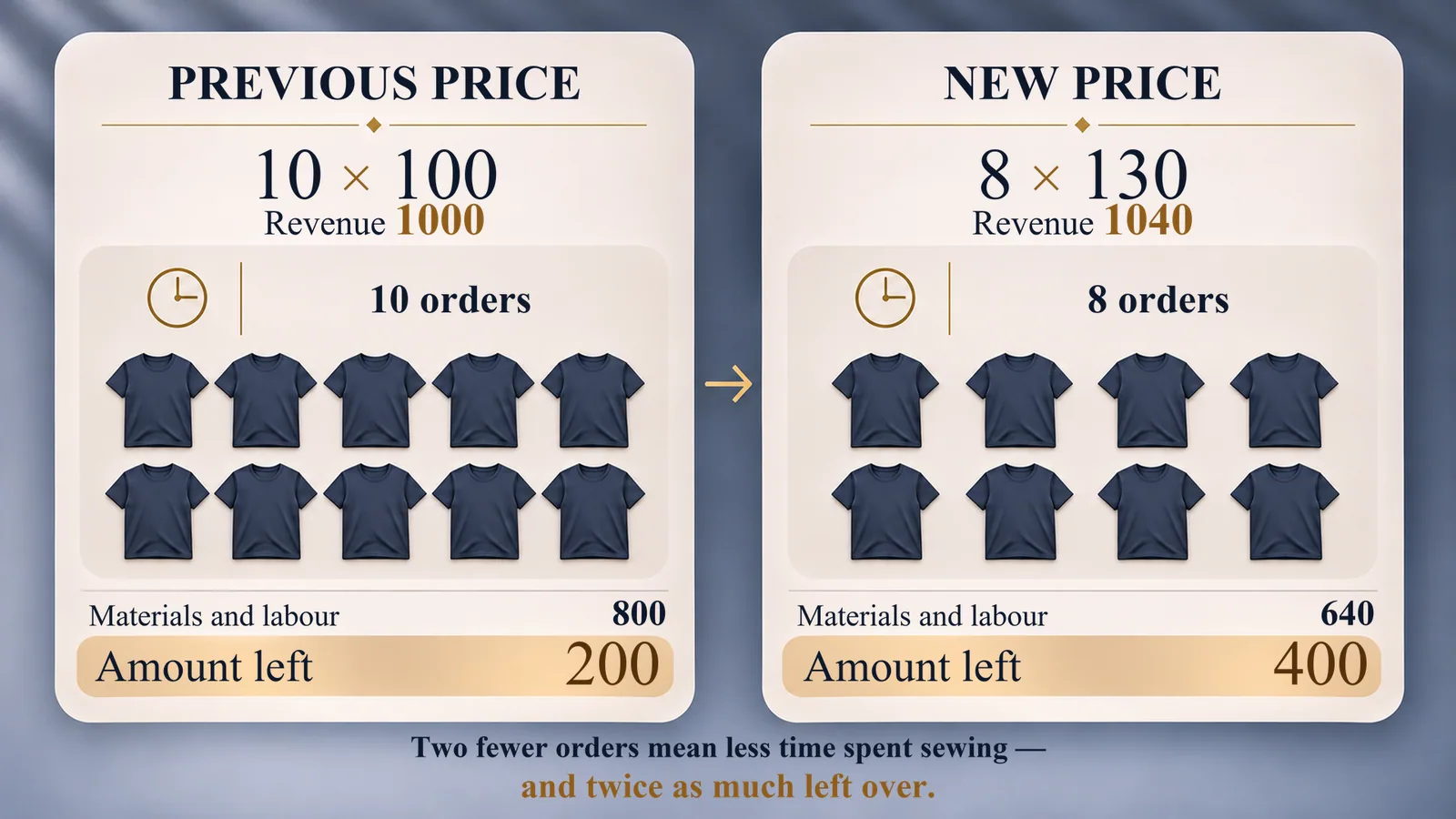
A price increase doesn't guarantee this result: some clients may say no, and every order costs something different. But before you worry about fewer orders, work out what each one really brings in.
4. How to make your offer worth more
Imagine someone offers you an ordinary hat for $10,000. You'd probably pass. Now imagine that for the same $10,000 they offer you a diamond necklace worth $50,000. The price hasn't changed, but suddenly it feels like the deal of a lifetime.

That's the whole principle: people pay more willingly when what they get is worth far more to them than what they pay.
Think about what would make your pieces more valuable to your clients. Maybe a custom set, an extra functional detail, or a service that saves them a hassle. Just make sure the extras are something people actually need, and that their cost is built into your price.
Value also comes from other things: trust in you as a maker, letting the client take part in the design, a piece no one else has.
5. How to tell clients about a price increase
In 1986, Daniel Kahneman, Jack Knetsch and Richard Thaler studied how people judge price changes. When a store raised prices because its own costs had gone up, most people found it acceptable. But when a hardware store raised the price of snow shovels the morning after a big snowstorm, most called it unfair: the store's costs hadn't changed, only how badly people needed a shovel.
So give clients notice and tell them why prices are changing. For example, you could send your regular clients something like this:
Price update from December 1
We wanted to let you know ahead of time that our sewing prices will change on December 1. The cost of materials and work has gone up, so we've had to review our rates.
Every order already confirmed will keep the price we agreed on.
Thank you for your trust! We truly appreciate you choosing our studio.

Another option is to let regular clients lock in the current price until a set date. This works especially well for people who've been meaning to order something but kept putting it off.
Book at current prices until November 30
Our sewing prices go up on December 1. If you've been planning a new order, you can still book it at the current price until November 30. Just confirm the details and pay the deposit by then. The sewing itself can be scheduled for later.
Thank you for staying with us!
Make this offer with your workload in mind: decide in advance how many orders you can take at the old price.
Not every client will accept the new price, and that's okay. But a good relationship shouldn't depend on you always giving up part of your income.
You've put so much time, energy and work into learning to make something you can be proud of. You deserve for it to bring you not just thank-yous, but a real living.