Where Does the Time Go? 10 Time Drains in a Sewing Business

You can spend the entire day working, get dozens of little things done, and still not finish what you had planned.
This morning's plan was to cut out a new order, finish the details on another, and prepare a pattern for the next order. But a client sent new design requests, you had to find a matching fabric, reply to messages, check a payment to a supplier, and take a few photos for social media.
All of these things are part of the job. Yet by the end of the day, far less time has gone into actual sewing than you expected.
For independent dressmakers and small sewing studio owners, there's much more to running a business than making garments. Client communication, sourcing materials, marketing, finances, and keeping the studio running all need attention.
Some of that work is essential. But certain everyday habits can quietly take up much more time than we ever intended.
We've put together ten familiar situations where working hours seem to disappear. You might recognize a few from your own day.
Fabric and supplies are fairly easy to price. Estimating the hours spent developing a design, sourcing materials, drafting patterns, arranging fittings, and communicating with clients is another matter.
The order is finished and paid for. But divide what you've actually earned by every hour spent on it, and the result may be surprising. Especially when much of that time was only roughly estimated in the first place.

2. Small client changes can mean hours of extra work
Yesterday, the design was finally approved. Today, the client sends another reference photo: "Could we do something like this instead?"
Move a seam, change the trim, try a different neckline. None of it sounds like a big change. But when one revision leads to another, the work starts to go well beyond the original agreement. The price, however, often stays exactly the same.
3. A full order book doesn't always mean a profitable business
Being booked weeks in advance sounds like good news. But it doesn't necessarily mean the studio is making good money.
One custom order might take twice as long as another, despite having a similar price. Then there are fabrics, shipping, equipment, and the cost of keeping the studio running. Two orders bringing in the same amount of money can leave you with very different profits.
It's easy to wonder where the earnings have gone when you've barely had a day off.

4. Creating content becomes a second job
Social media is part of running a small sewing business now. And sometimes a single post takes almost as long to prepare as a small sewing order.
First, you need good photos or footage. Then comes choosing clips, editing a Reel, finding music, writing a caption. Tomorrow, there's another post to think about.
And not every piece of content brings in a new customer. The hours are spent, whether the enquiries arrive or not.
5. Constant interruptions make it harder to finish a job
You're in the middle of cutting fabric when a client calls. By the time you've finished discussing the fitting, there's a message about a delayed delivery. Ten minutes later, someone wants a quote.
None of these conversations takes particularly long. But returning to precise work after each interruption isn't always easy. You have to check where you left off, go over the details, and get your concentration back.

6. Switching between tasks can take over the entire day
Sometimes nobody needs to interrupt us. We manage that perfectly well ourselves.
Remember an invoice that needs sending, open your email, check whether a deposit has arrived, notice a fabric that might work for another order. Half an hour later, you're back where you started.
Everything needed doing. Yet somehow the day has turned into a collection of half-finished tasks.
7. Manual bookkeeping takes more time than it should
An invoice to send, a deposit to check, materials to record, a receipt to find for the accountant. Each task is small enough, but together they can take a surprising amount of time.
Especially when the accounts are managed manually. Figures get copied from emails into spreadsheets, documents need tracking down, and calculations are checked again. Much of this repetitive work can already be handled by bookkeeping and invoicing software.
8. Looking for inspiration turns into endless scrolling
You open Pinterest to find an interesting sleeve detail for the next order. Then you notice some beautiful embroidery, an unusual color combination, and a new collection from a designer you follow.
An hour later, you've saved dozens of images. But you're still no closer to deciding what to do with that sleeve.
What started as design research has quietly turned into scrolling.
9. A poorly arranged sewing studio creates extra work
Even a perfectly tidy studio isn't necessarily easy to work in. The notions you need are stored at the other end of the room, patterns are kept separately from their orders, and supplies for the next garment have to be collected from several cupboards.
A few minutes here, another few there. Hardly worth noticing on their own, until you realize how often the same little trips happen throughout the day.
10. We try to do too much ourselves
Design the garment, draft the pattern, cut, sew, embellish — all on your own. Even with a full order book, hiring a studio assistant or commissioning a freelance designer can feel like an unnecessary expense.
But how many more orders could you take on with some of that time freed up?
What Small Business Research Tells Us
The struggle to find enough time isn't unique to sewing businesses. Research across different industries shows how much attention running a business demands beyond the work itself.
41% Of new U.S. solopreneurs identified time management as one of their biggest business challenges.
57% Of U.S. small business owners surveyed said managing their time or maintaining work-life balance had become harder in 2025.
63% Of UK businesses surveyed agreed that the time spent complying with regulations was a burden.
UK Department for Business and Trade, Business Perceptions Survey 2024
These findings cover businesses across different industries, not sewing businesses specifically.
Sometimes a Change in Approach Is All It Takes
Not every task can be eliminated, and time spent away from the sewing machine isn't necessarily wasted. Working with clients, developing designs, and growing a business all matter.
But it's worth taking a closer look at where the working day actually goes. Some tasks could be simplified, others automated, and some shared with another person.
Order log
A simple place to start: for a few weeks, write down how long each order really takes. Two free printable sheets make it easy — order cards and a monthly table.
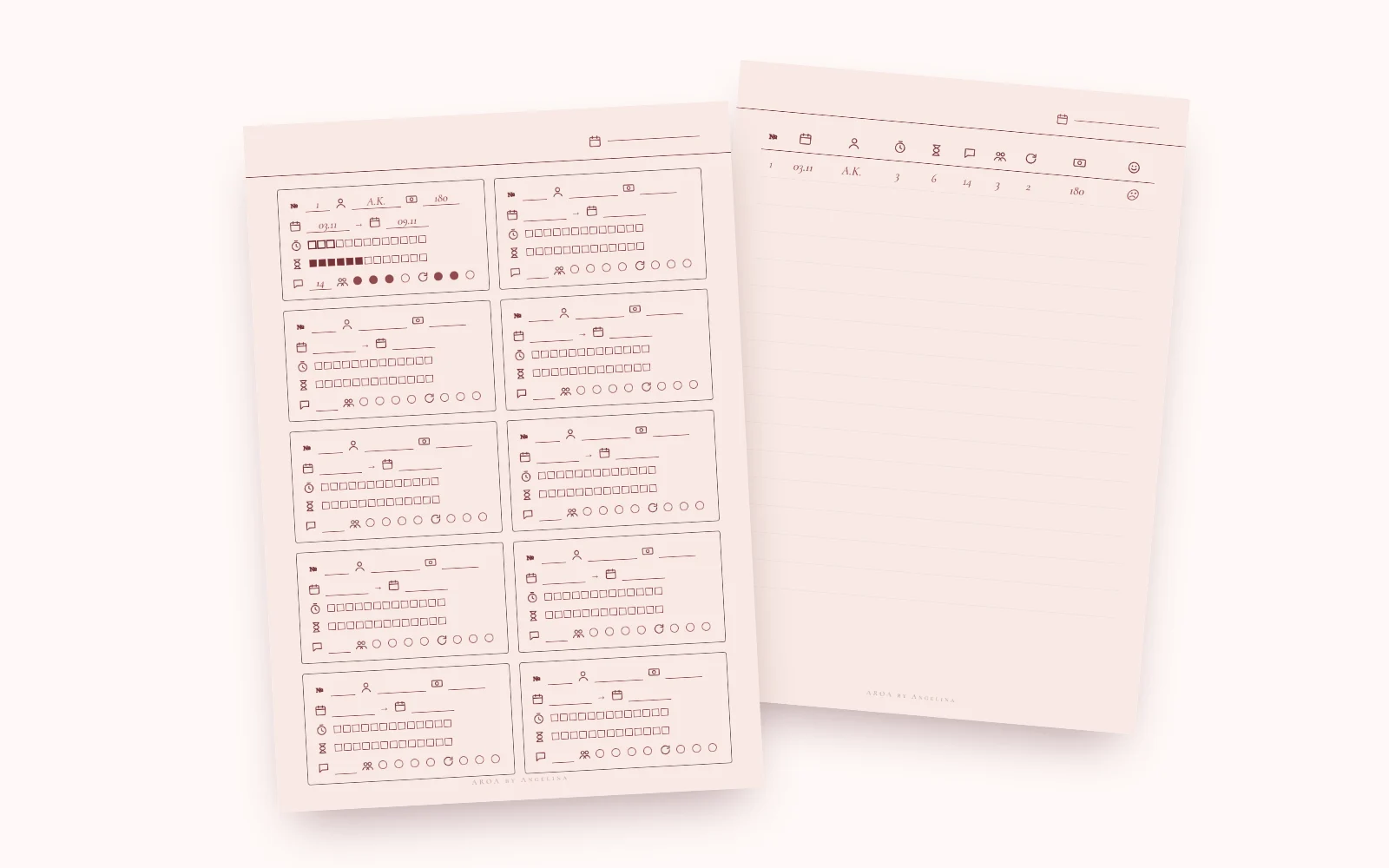
In a month, you’ll know rather than guess how long an order really takes. And you’ll be able to name a deadline and a price you feel sure about.
Time is the one resource we can never get back. And how we choose to spend it affects not just what we earn, but how much of our lives we get to enjoy outside the studio.