How many orders you need just to break even
Five simple questions that show whether your studio is actually making money.

Every maker can name the price of her work without thinking twice. But ask how many orders a month it takes just to avoid losing money, and very few can answer. It's not that we're bad with numbers. We were taught to cut and sew, and we learn to run a business on the go, often through our own mistakes.
Every studio has expenses that arrive every month, whether there are orders or not: rent, electricity, phone, taxes. The first orders of the month go towards paying them. Until they're covered, you're working at a loss. The moment every expense is covered is called breaking even. Everything you earn after that is your profit. Most makers don't know which order of the month gets them there, so they go by feel: lots of orders, so things are probably fine.
Mike Michalowicz, author of «Profit First», a book about money in small businesses, warns: «You can't grow out of your profit problem». If each order leaves you almost nothing, more orders bring more work, not more money.
Start by writing down all your fixed expenses. There's a simple test: if you had no orders at all next month, would this expense still be there? Rent, or part of the household bills if you sew at home, phone, software, an accountant, taxes all stay. People usually forget machine servicing and the money for new equipment when the old one gives out.
But most often the most important item is missing from the list: your salary. Not «whatever's left», but the amount you actually want to live on. If it isn't on the list, the month can balance perfectly and you've still worked it for free.

2. How much does one order really bring you?
A payment for an order isn't yet your income. Part of it belongs to the piece straight away: the fabric and notions that went into it, bank fees, packaging, delivery. Only what's left works for your expenses and for you. The easiest way to see this is to look at a few past orders: remember what came from your stock for each piece and what you had to buy.
3. Can you break even within the month?
Expenses run every day: on your day off, when you're ill, and on days with no orders. But money only comes from days of paid work. So count your month honestly: without days off, public holidays and vacation, and with some room in case you get sick.
Now compare how many orders it takes to cover all your expenses including your salary, and how many orders you can actually finish in those real working days. We almost always picture ourselves faster than we are: an order looks like a couple of days, but with messages, fittings and changes it takes a week. An order log helps you find your real pace: after each order, you note how many days it actually took. You can download it for free in the article «Where Does the Time Go? 10 Time Drains in a Sewing Business».
If even fully booked you can't reach break-even, new clients won't help: you simply won't have time to sew their orders. Five things can.
Time. First, look at where your hours go besides sewing. Message templates for clients, ready-made blocks for styles you repeat, one supply run a week instead of a trip for every order, online booking for fittings. Everything you can simplify or automate frees up time for the work you actually get paid for.
Helpers. Having more orders than you can handle isn't a reason to turn them down. In the article «If I Were Starting From Scratch: How to Turn a Love of Sewing Into a Real Business» I wrote: «When everything depends on one person, the business can only grow as far as that person can stretch». You can start small: hand over what doesn't need your particular skill, such as finishing, pressing, sewing on fastenings, shopping for supplies or bookkeeping. You can pay per task or agree with another maker to take part of the orders. Keep for yourself what clients come to you for: your own design, your way of communicating with clients, your personal know-how. A helper pays off when you use the freed-up time for work that brings in more than their work costs.
Expenses. Go through your list and ask about every item whether you really need it. Michalowicz writes: «Eliminating unnecessary expenses will bring more health to your business than you can ever imagine».
Extra services. Rush orders, complex finishing, alterations after a fitting. If they're in your price list from the start, an order brings more without looking for new clients.
Price. The more each order brings, the earlier in the month you break even. But rethink your price carefully, or you may lose clients.
And if you break even before the end of the month, see how much earlier. That's your cushion for a quiet season, illness or a holiday.

4. Where does the money go?
Sometimes the price is right and there are enough orders, yet by the end of the month there's nothing left. Usually the money leaks out in three places.
Order money gets spent as your own. A deposit arrives and it feels like you've already earned it. But that money still has to buy what's missing and pay for the work. Michalowicz suggests flipping the usual order: not «income minus expenses equals profit», where profit is whatever happens to be left, but «sales minus profit equals expenses». In other words, every payment is split right away: materials, taxes, studio expenses, your salary and a little profit, instead of waiting to see what happens to be left at the end of the month. His advice: «Run your business based on what you can afford to do today, not what you hope to be able to afford someday». In practice this means separate accounts or envelopes, so every dollar has a job.
Money sitting on the shelf. Fabric bought in advance is money you can't use for rent or pay yourself with until it becomes a paid piece. Keep in stock only what goes into almost every order: thread, zippers in everyday colours, interfacing. Expensive and special fabrics are better bought for a specific order, after the deposit. Once a season, go through the shelf: whatever has been sitting there longer than a season can go into small pieces or samples, or be sold to other makers.
Time nobody pays for. A cancelled fitting, an extra meeting, a redo at your own cost. An order that stretched over a week can take more than it brought, even though the client paid the full price. So state in your terms in advance how many fittings and changes are included in the price.
5. What else to check?
Every studio has its own small things where money slips away. Tick the ones you recognise:
- discounts and «a better price for friends». A discount lowers the price, but not what you've already spent on the piece, so you pay for it entirely out of your own earnings. If you want to do something nice, add a little extra instead;
- small jobs eat into the time for big ones. A quick alteration feels like easy money but takes hours that could have gone into a piece that pays more;
- taxes as a surprise. If you don't set money aside from every payment, they always arrive at the wrong time;
- free consultations and sketches. If a client leaves after long discussions, you've given that time away;
- clients who delay the final payment or don't collect their order. The work is done, the fabric is used, and there's no money;
- one wallet for home and business. Then it's impossible to see how much the studio really earns.
Cheat sheet
We've put all these questions into a cheat sheet. Tick what you recognise in your own work, and you'll see right away where to start in your studio.
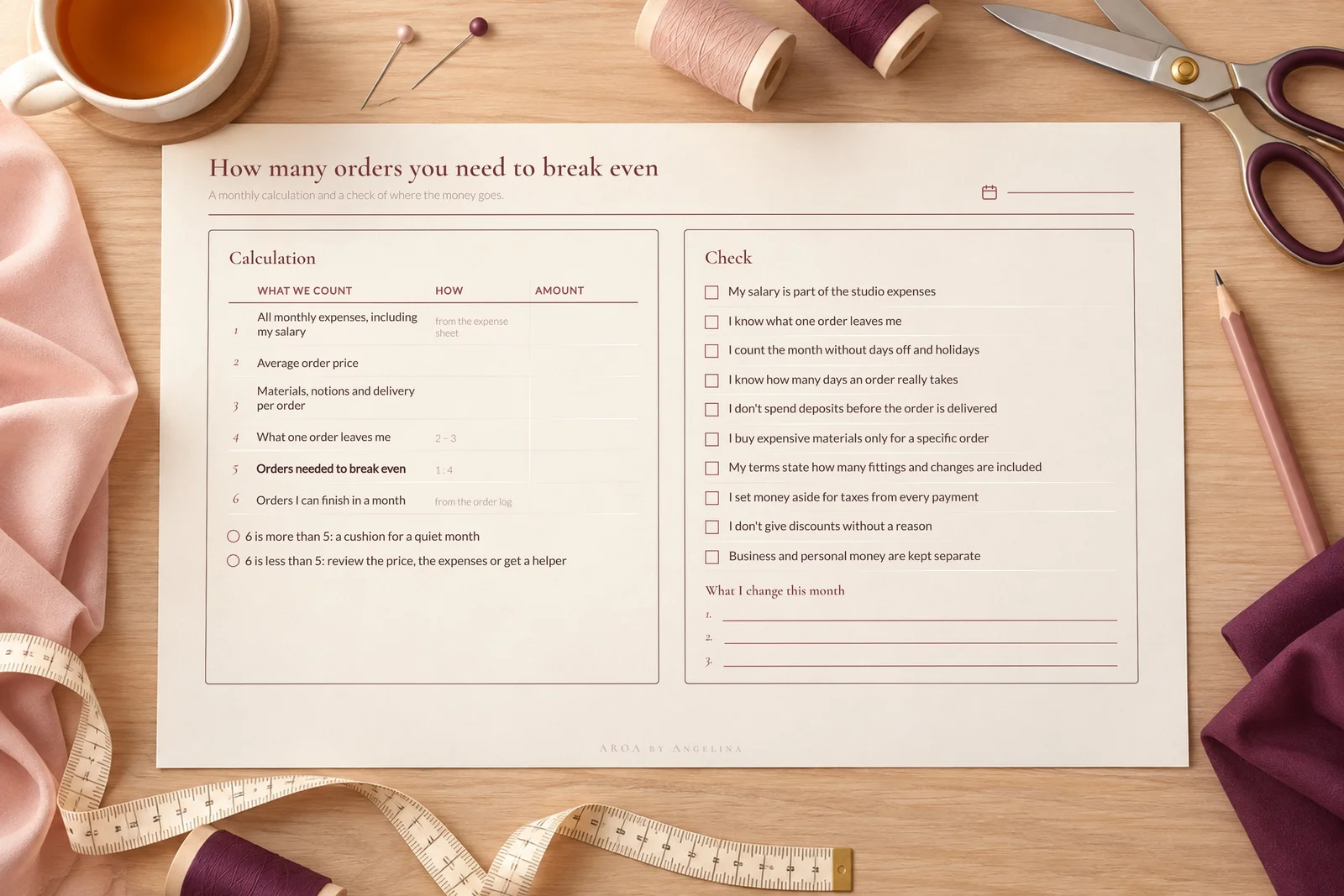
Most often, after a check like this, it becomes clear that it's time to raise your price. And for some reason that feels scarier than working at a loss. Where this fear comes from and how to deal with it is what we'll look at in the next article.
Performance costume patterns are in the AROA Patterns catalog. Your first pattern is a gift.
Open the catalog →