4 Ways to Get a Client's "Yes" Without a Discount
The client loved your work. You talked through the style, the fabric and the deadline, and worked out the price. Then you sent the number and got the line every maker knows: "Thanks, let me think about it."
Maybe they expected a lower number. But cutting your price before you understand what is holding them back is rarely the best move.
In custom sewing, a client pays for something that doesn't exist yet. They can't try it on, check the fit, or see how it will look on them. So the decision depends on more than the price: how clearly they can picture the result, whether they can trust the maker, and how the work will be organized.
Entrepreneur Alex Hormozi, in his book $100M Offers, describes four things that make up perceived value: the outcome the buyer wants, how sure they are of getting it, how long they have to wait, and how much effort it takes from them.
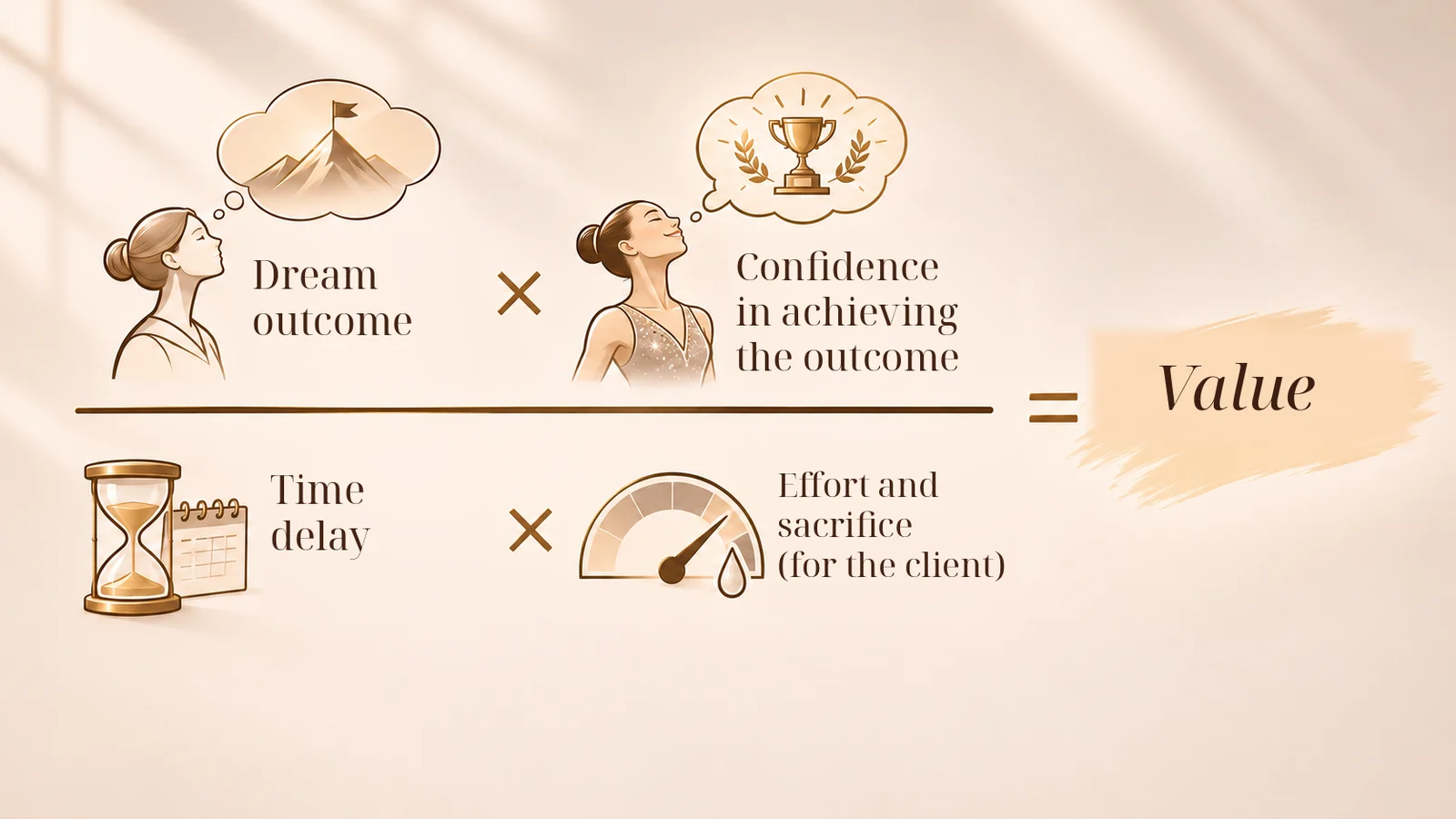
These ideas fit a small sewing business well. And you don't need a discount to use them.
At the heart of Hormozi's first principle is the outcome a person is willing to pay for. In custom sewing it isn't always obvious. A client may bring you a photo of a dress they like, but what exactly drew them to it? A silhouette that flatters their figure, an unusual design, or the chance to create a special look for an important event? Try to find out before you get into fabrics and construction details. Ask what they like most about the look, which details they would change, and what absolutely has to stay. Once you understand what they expect, you can suggest the right design and focus on what really matters to them.
But even after a detailed talk about the design, it can be hard for a client to picture the finished piece. AI can help here. From a sketch or a photo, you can create a realistic image of the garment on a model, compare several options, and see how the chosen colors and details work together. The closer the design is to the look the client has in mind, the more it is worth to them.
We've prepared a "Virtual Fitting" prompt that helps you show a future costume or any other garment on a model.
Create a photorealistic virtual fitting of the exact customer wearing the exact reference garment, presented in two full-body studio views.
REFERENCE LOCK
Customer photo controls identity and anatomy: Preserve facial features, age, skin texture, hairstyle, natural body silhouette, shoulder-to-hip ratio, bust, waist, pelvis, buttock volume, thigh thickness, and leg length. No beautification, slimming, widening, reshaping, or invented curves.
Garment photo controls clothing only: Faithfully transfer its silhouette, construction, neckline, cutouts, seams, fabric, transparency, colors, patterns, and exact embellishment placement. Never transfer the original garment model's anatomy.
ANATOMICAL CONSISTENCY Use the customer's original body as the fixed anatomical reference for both views. Rotate the camera, not the body proportions. The 30° view must preserve realistic depth without increasing hip width, buttock projection, pelvic volume, or thigh thickness. Do not substitute generic model anatomy or alter the body to fit the garment.
TWO VIEWS
Front view (0°), preserving the customer's original proportions.
Subtle three-quarter front view (30°), showing the same person and garment from a different angle.
STUDIO PRESENTATION Two equally sized portraits side by side. Each figure occupies 90–95% of its panel height, fully visible from head to bare feet. Natural standing posture, relaxed arms slightly away from the torso. Eye-level camera, consistent distance, 85mm-equivalent perspective.
Warm ivory background (#F5F0E8), soft directional studio lighting, natural skin tones, neutral-white garment illumination, and sharp fabric and decorative details.
Remove unrelated accessories and existing watermarks. No text, props, additional people, or stylization.
FINAL RULE: Reference accuracy overrides aesthetics. Preserve the customer's actual anatomy and the garment's original design. Do not reinterpret either reference.
Important: this prompt is for virtual fitting of clothing on adults (18+) only. The image helps you discuss the design and agree on the details before sewing begins. It does not replace a real fitting and cannot guarantee an accurate picture of the fit or how the fabric will behave.
2. Put your agreements in writing
A client's trust is built on more than a beautiful portfolio, reviews and experience. How clearly and professionally you run your orders matters just as much.
One of the best ways to show you take the work seriously is to agree on the main terms with the client in writing before you start.
It doesn't have to be a long, complicated document. What matters is that both sides understand the same thing: what will be made, which materials and work are included in the price, how many fittings there are, when the order will be ready, and how payment works.
You can also attach the approved sketch, a description of the piece and a list of the chosen materials. That prevents misunderstandings and keeps every agreement in one place.
This protects both sides. The client knows what they are paying for and what to expect. And the maker has clear terms to rely on while doing the work.
It is clear terms, not a promise that "it will all turn out great", that build trust before the client pays a deposit.
3. Shorten the wait
In $100M Offers, Alex Hormozi writes: "The only thing that beats free is fast."
The less time passes between paying and getting the result they want, the more valuable the offer feels to the client.
For a sewing business, this doesn't mean sewing in a rush at the cost of quality or promising unrealistic deadlines. Sometimes it is enough to rethink how you organize your work, shorten the gaps between stages, and make sure you have the materials ready in advance.
But Hormozi has one more interesting thought: it matters not only how long it takes to get the final result, but also what the client gets along the way.
The client doesn't have to wait until the whole order is finished. Show them progress that lets them truly see the work done so far and how the piece is slowly taking shape.
That way they start to feel the value of your work long before they hold the finished piece.
4. Reduce the client's effort
The last part of Hormozi's value equation is about the effort a person has to put in to get what they want. The easier the whole process is for the client, the more attractive your offer becomes.
In custom sewing, clients pay in part so that a professional takes a big share of the work off their hands. The fewer things they have to figure out themselves, the more valuable your service becomes.
Think about which steps you can take on yourself and which you can make easier. For example, offer a few suitable fabrics instead of a huge catalog, prepare a guide to taking measurements, or explain in advance how the approval process works.
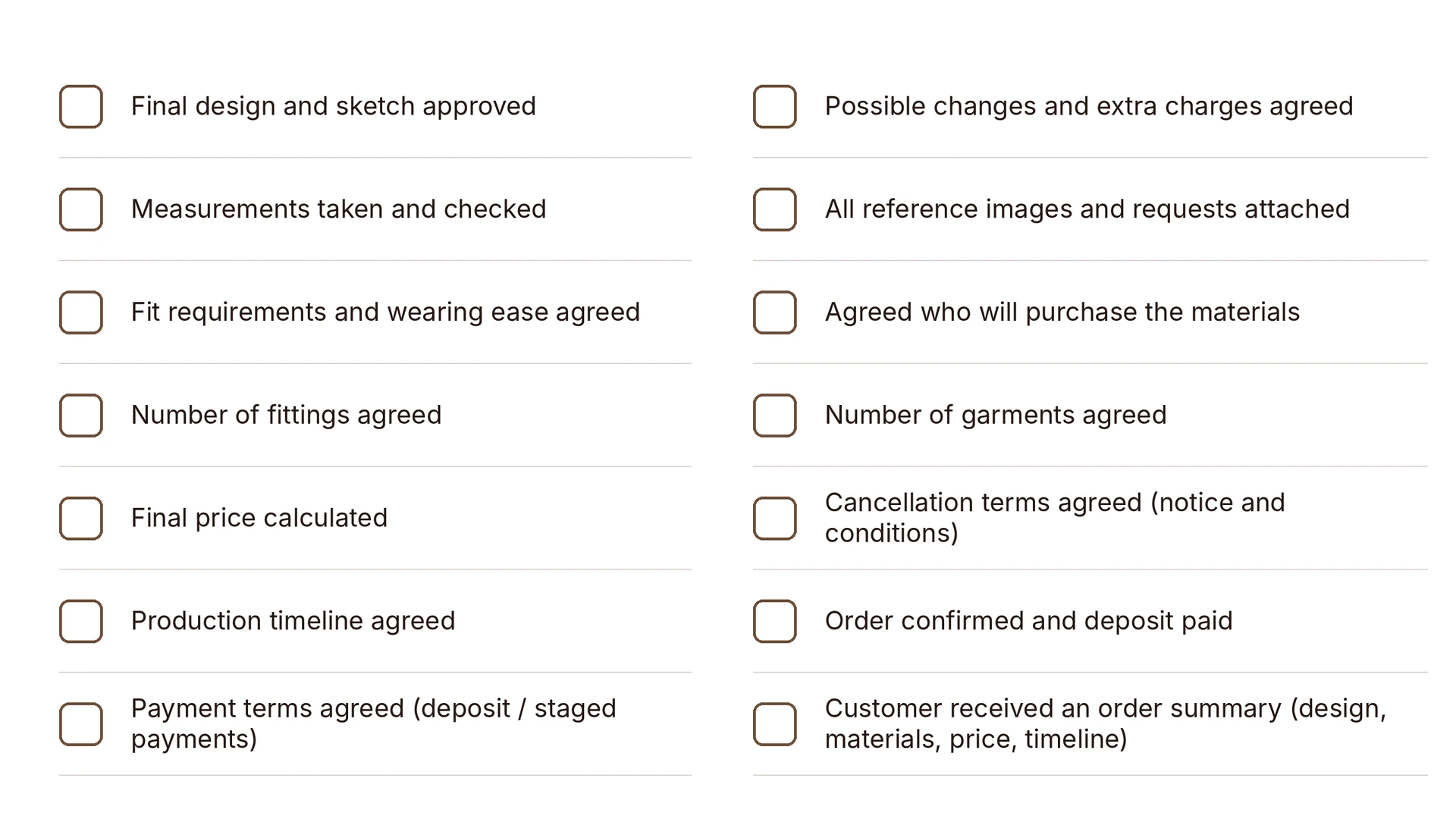
An order checklist helps here. You can gather in it every question to go over with the client: from choosing the design and materials to fittings, price and payment terms. It saves time for both sides and becomes the basis for your written agreement.
What if it really is about the price?
By the time you discuss the price, you and the client have already chosen the style, picked the materials and agreed on the details and scope of the work. They now understand much better what the price is made of.
If the total is still over their budget, you can go back to individual parts of the order and see where it can be adjusted. For example, choose a different fabric, simplify the construction or cut back on decoration.
Explain how each change will affect both the price and the look of the piece. The client can then decide which details matter most to them and which they are ready to give up.
The result is not a discount on the original order but a different version with a price that makes sense, and you keep the value of your work.
Why a discount can cost more than it seems
A 10% discount sounds small, but for a maker it can mean a much bigger loss of earnings. Say you charge €200 for sewing a dress, and €120 of that goes to materials and other costs of the order. That leaves €80 to pay for your work and cover your studio expenses. After the discount the client pays €180, and you are left with €60. So a 10% discount cut what you keep by 25%, even though the work stayed exactly the same.
That is why, when you work out a discount, you need to look not only at the price of the piece but at how much money is left after all the costs. We looked at this in more detail in the article Why raising your prices feels scarier than working at a loss.
The value of your work is more than the finished piece
When someone comes to you for custom sewing, they are choosing more than a garment. They are choosing a maker they are ready to trust with their idea. Your experience, your skill in finding the right solution, your eye for detail and the way you run your work all have value too, even if they never appear as a separate line in the price.
The better a client understands what stands behind your work, the less reason there is to reduce the whole conversation to the price. Not every order will end in a sale, but respecting your own work and having clear terms helps you build relationships with the clients who truly value what you do.
Performance costume patterns made to individual measurements, in minutes. More time for the sewing, less for drafting.
Get your first patternTo get your first pattern for free, you just need to register.